

Maritime Pine Forestry
Genetic improvement of the Maritime Pine
- Details
-
The Landes of Gascogne are the first European, cultivated forest, in terms of productivity and surface area.
The maritime pine genetic improvement programme led by INRA started in 1960, with the successive planting of seed orchards with different levels of genetic improvement.
The main objectives of genetic improvement are to produce trees with straighter trunks and better growth rates, although new criteria such as resistance to drought and disease are now also being studied.
Since the 1960s, successive generations of improved seeds have been used across the forest, each gradually being replaced by a new, higher-performing generation. The current programme plans the arrival of the 4th generation of genetic improvement (VF4) in 2024.
Since 1995, the improvement programmes have been coordinated by the PMF GIS (Groupe Pin Maritime du Futur – Future Maritime Pine Group), and by all forestry stakeholders (INRAE, ONF, FCBA, CNPF, CPFA and private companies)
Chronicle of the genetic improvement:
1926: Installation of the first arboretum of Maritime Pines coming from different natural areas.
1960-1969 / 1972-1974: selection campaign of trees which have superior growth and shape which lead to the planting on 246 hectares of seeds' orchards 1st generation.
The limited quantity of seeds genetically improved and their high cost has modified the reforestation method, replacing progressively the sowing by the planting. The seed is sown in a nursery to produce genetically improved plants.
Indeed, 1 hectare of sowings requires 3 kg of seeds, that is to say 45 000 seeds. In a nursery, 45 000 seeds produce 40 000 plants, or 30 hectares of forest replanted instead of 1 hectare if using seeds.
1978-2000: Gradual use in reforestation of sowing seeds coming from 1st generation, seeds 'orchards.
1986-1995: Installation of seeds' orchards of 2ndgeneration on 200 hectares.
Since 1998: Gradual use of seeds coming from 2nd generation' seeds' orchards.
2003-2006: Installation of seeds' orchards of 3rd generation (VF3)
2006: Installation by PLANFOR of a seeds' orchard of 3rd generation, 17 hectares 60 in Carcans (33). The planting chosen by PLANFOR should allow an early harvest of Pine comes in 2013.
2012: First harvest in the seeds' orchards VF3.
2013: Gradual use of seeds coming from 3rd generation seeds orchards.
2017-2019: Establishment of the 4th-generation seed orchard at Lanton France(VF4.1)
2017-2019: Establishment of the 4th-generation seed orchard at Mimizan France (VF4.2)
2021-2023: Installation of the 4th generation seed orchard in BeychacFrance.(VF4.3)
2023-2024: First seed harvest from the Lanton orchard France(VF4.1)
VF4, a continuously deployed genetic improvement
The 4th generation of the Landes vigour-form variety represents a turning point in the forest’s genetic improvement strategy, as it is a continuously deployed generation: small seed orchards will be regularly established through to the 2030s.
Thanks to new genetic marker models and precise knowledge of the genealogy of selected parent trees, it is now possible to predict the performance of a generation. This is possible without even needing full feedback on offsprings quality which saves several years between each selection programme.
Therefore, new generations will be introduced more quickly, with a new VF4 formulation approximately every 3 years (compared with 15 years for previous generations). In addition, selection criteria will be more rapidly adaptable from one generation to the next. 489
Each generation of seed orchards represents an improvement over previous generations.
Compared to VF3, VF4 plants show significantly higher estimated gains at 35 years old in key areas such as:
- Volume:
- Straightness: straighter trees.
- Branching quality: notably a reduction in forking. - Photos (1)
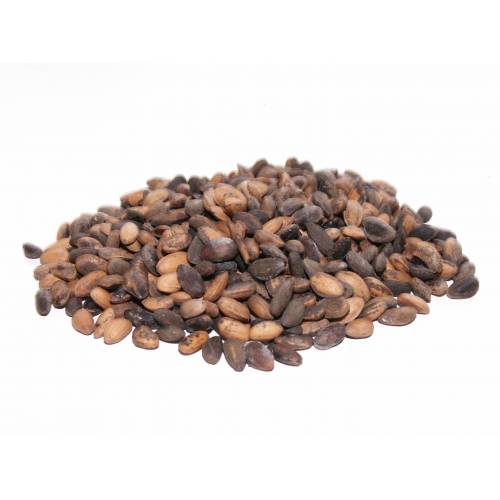
Genetic improvement of the Maritime Pine
Since the autumn 2013, gradual use of seeds coming from 3rd generation seeds orchards.
Author: Planfor
Copyright
Copyright